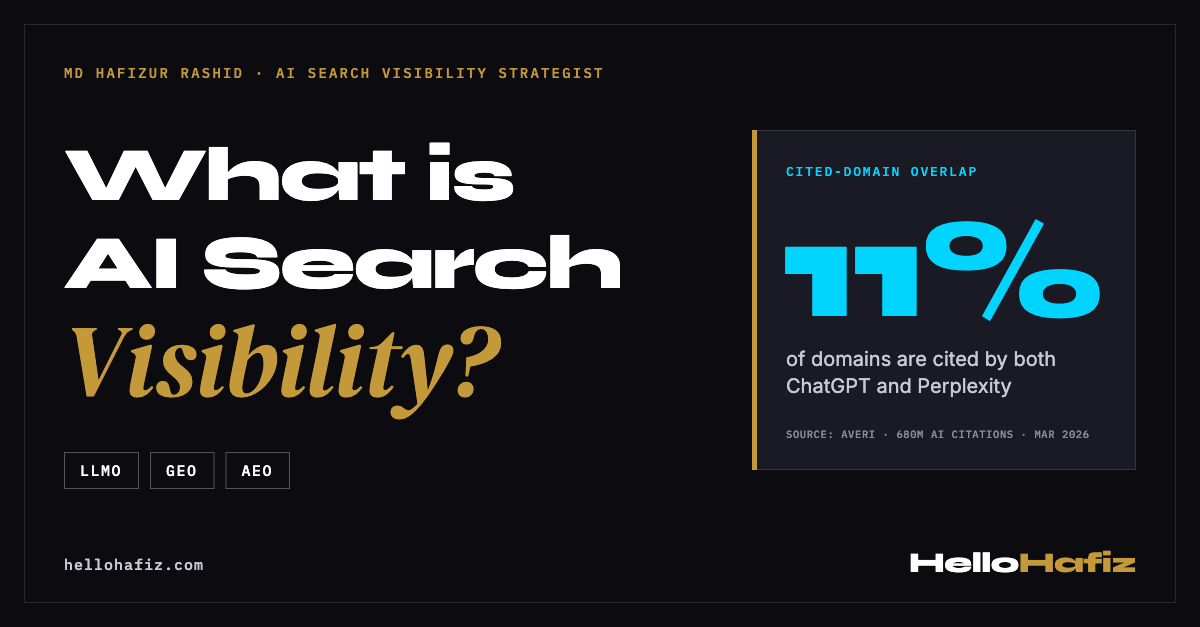
AI search visibility is how often a business, brand, or person is named and cited when buyers ask ChatGPT, Gemini, Perplexity, Claude, or Google AI Overviews a question in their category. It is measured per query and per platform, because each engine selects its sources differently. In an analysis of 680 million AI citations, only about 11% of domains were cited by both ChatGPT and Perplexity (Averi, March 2026).
I am Md Hafizur Rashid, Founder of DAIV (Dominate AI Visibility). For a Tampa-based independent commercial insurance agency, this exact work produced 29 verified leads in Q2 and 56 verified leads in Q3, tracked directly via utm_source=chatgpt in GA4. That number is a conservative floor. It counts only the leads AI platforms explicitly tagged, excluding the untracked prospects who read an AI answer and then searched for the agency by name.
This guide covers what the core terms mean (LLMO, GEO, AEO), what the actual work involves, and how to measure it honestly.
How is AI search visibility different from SEO?
SEO earns a position on a results page. AI search visibility earns a mention inside the answer itself, often with no results page at all. The two overlap less than you might expect: only 8% to 12% of ChatGPT-cited URLs also sit in Google’s top 10 organic results (QuickSEO roundup of 2025–2026 studies).
Here is how the two disciplines compare across four key areas:
- Unit of success: A ranked page (SEO) vs. a named citation in an AI-generated answer (AI search).
- What it rewards: Relevance, backlinks, and page experience (SEO) vs. entity clarity, third-party mentions, and direct answers an engine can lift (AI search).
- Where it shows: Google and Bing results pages (SEO) vs. ChatGPT, Gemini, Perplexity, Claude, and AI Overviews (AI search).
- How you measure it: Rank trackers and Search Console (SEO) vs. repeated prompt sampling and GA4 AI referral tracking (AI search).
| Traditional SEO | AI search visibility | |
|---|---|---|
| Unit of success | A ranked page | A named citation in an AI-generated answer |
| What it rewards | Relevance, backlinks, and page experience | Entity clarity, third-party mentions, and direct answers an engine can lift |
| Where it shows | Google and Bing results pages | ChatGPT, Gemini, Perplexity, Claude, and AI Overviews |
| How you measure it | Rank trackers and Search Console | Repeated prompt sampling and GA4 AI referral tracking |
SEO still matters. Google AI Overviews and ChatGPT’s search features pull from web indexes, so a slow, poorly structured site will rarely get cited anywhere.
What do LLMO, GEO, and AEO each mean?
These three terms describe overlapping parts of the same objective. AI search visibility is the outcome all three serve.
- LLMO (Large Language Model Optimization): Ensuring language models understand and describe an entity correctly. This means the same name, role, and facts appear consistently across every source a model reads or retrieves.
- GEO (Generative Engine Optimization): Shaping content so generative engines retrieve and cite it when writing a synthesized answer.
- AEO (Answer Engine Optimization): Formatting content as direct answers, using question-style headings, short definitions, and FAQ schema so an engine can lift one passage cleanly.
In practice, LLMO decides whether a model knows who you are. GEO and AEO decide whether it picks your page when it answers.
Why does one ranking screenshot mislead?
A single AI answer is a sample of one. Engines change their sources weekly, and they frequently disagree with each other.
- Platforms barely share sources: With roughly 11% domain overlap between ChatGPT and Perplexity, a win on one tells you little about the other.
- Citation patterns swing: ChatGPT cited Reddit in nearly 60% of responses in early August 2025, then dropped to around 10% by mid-September (LLM Pulse).
- Answers vary by phrasing: The same question asked twice can return a different shortlist of sources.
I do not report “#1 in ChatGPT” based on a single screenshot. I report citation rates from repeated tests across platforms, paired directly with qualified prospects that can be traced in analytics.
What does an AI Search Visibility expert actually do?
The work follows a fixed sequence. I call it the Entity Visibility Framework™ (EVF): three pillars, each built on the one before it. I operate on a “One relationship, zero hand-offs” principle, ensuring single-point accountability throughout this process.
- Technical Foundation: Page speed, Core Web Vitals, crawlability, clean site architecture, and precise tracking. Engines cannot cite a page they struggle to fetch or parse.
- Entity Authority: Clear identity signals. This includes Organization or LocalBusiness schema, Service and FAQPage schema, sameAs links to the business’s verified profiles, and consistent details across directories and reviews. This answers who you are, what you do, and why you are credible.
- Citation Optimization (GEO and AEO): Answer-first service pages, question-led headings, FAQ sections, and long-form topical content an engine can quote.
Skipping a pillar weakens everything above it. Content written before the technical foundation is solid tends to underperform, regardless of its quality.
What does this look like with a real client?
Elite Business Insurance, LLC, is a BBB A+ rated independent commercial insurance agency in Tampa, Florida. Over an ongoing engagement with zero paid advertising, the EVF sequence produced the following verified results within the first 90-day window:
- Organic traffic increased 761%, and impressions increased 488% (Google Search Console).
- Mobile PageSpeed score improved from 48 to 96.
- 18 high-intent landing pages built, up from 3.
- 86 keywords ranking on page one.
Most importantly, this work translated into a phone that rings with qualified prospects. ChatGPT became the agency’s third-largest referral source in GA4. We tracked verified, AI-tagged leads (utm_source=chatgpt) conservatively in the client’s CRM by quarter:
- Q2 (April–June): 29 verified AI-tagged leads
- Q3 (July–September): 56 verified AI-tagged leads (up 93% from Q2)
These 85 tracked leads represent a conservative floor, counting only prospects who arrived with an explicit AI-source UTM tag. Crucially, these leads were entirely incremental. They arrived in addition to the agency’s baseline organic and direct lead flow, proving that AI search visibility builds a net-new pipeline rather than just shifting existing attribution.
Furthermore, visitors who read an AI answer and then searched for the agency by name never carry that tracking tag, meaning the true influence is even higher. The 93% growth from Q2 to Q3 demonstrates the compounding effect of sustained entity and citation building.
How should businesses in Bangladesh and South Asia approach this?
Ask an AI tool for the best clinic, school, or digital marketing agency in a Bangladeshi city, and you will often get a thin answer built from a few directory listings. Few local businesses publish the structured, sourced content these engines prefer, meaning the first ones to do so have a massive advantage.
I work from Dinajpur, North Bengal, with clients in the US, the UK, Europe, Australia, and South Asia. The same sequence applies:
- Fix the website first: I rebuilt the site for Zia Heart Foundation Hospital & Research Institute, a cardiac hospital in Dinajpur, prioritizing speed optimization and on-page structure before any advanced work.
- Maintain one identity everywhere: The same English name spelling, address, and phone number across the website, Google Business Profile, Facebook page, and directories. Add the Bangla name as an alternate, not a replacement.
- Earn coverage beyond your own site: National press, industry associations, and partner sites carry significantly more weight for AI citations than your own pages.
How do you measure AI search visibility?
I use two distinct measures and keep them in separate reports because they answer different questions.
1. AI Presence Rate (APR) answers: “How often are we named?”
- Pick the 20 queries your buyers actually ask (e.g., “commercial insurance agency in Tampa” or “top roofing companies in NYC”).
- Run each one on ChatGPT, Gemini, Perplexity, and Claude (80 total tests).
- Count every test where your business is named or cited.
- APR = (cited tests ÷ total tests) × 100.
- Repeat the full set on different days and report the average, as a single run is mostly noise.
2. AI-Attributed Leads answers: “Is it paying?”
Ensure GA4 and your form tool capture UTM parameters, then count submissions tagged ChatGPT, Gemini, or Perplexity. Treat that count as a conservative floor, never the total.
Frequently Asked Questions
What does an AI Search Visibility expert do?
They make a business easy for AI engines to identify, trust, and cite, then measure how often it is named and how many qualified prospects that brings. The work combines technical infrastructure, structured data, entity building, and answer-first content.
How long does it take to get cited by AI tools?
Technical fixes show up in Search Console within weeks. Citations follow as entity signals and third-party mentions build. Elite Business Insurance logged its first ChatGPT-tagged lead in late March, scaled to 29 leads in Q2, and grew to 56 verified leads in Q3, demonstrating compounding returns within a standard engagement window.
Is LLMO the same as SEO?
No. They share a technical base, but LLMO focuses on how models understand and describe an entity, while SEO focuses on traditional page rankings.
Does press coverage matter more than my own website?
Often, yes. Muck Rack’s May 2026 study found earned media made up 84% of AI citations across ChatGPT, Claude, and Gemini (summary via AuthorityTech).
Why publish this on LinkedIn?
Meltwater’s analysis of 9.5 million AI citations ranked LinkedIn second only to YouTube, with 75% of LinkedIn citations coming from individual members (Meltwater, May 2026).
About the Author

Md Hafizur Rashid (HelloHafiz) is an AI Search Visibility strategist and LLMO consultant based in Dinajpur, Bangladesh. He is the founder of DAIV (Dominate AI Visibility), a full-stack digital growth agency built exclusively for independent insurance agencies and high-trust local service businesses, and the creator of the Entity Visibility Framework™ and the AI Presence Rate (APR) metric. Since 2011, he has completed more than 1,000 web, SEO, and content projects and holds Top Rated status on Upwork and Fiverr. He works with service businesses in the US, the UK, Europe, Australia, and South Asia.
Email me with the word “EVF” and I will send it to you.
Email “EVF” to hello@hellohafiz.com →